On the Edge is a series of artistic projects and gestures that set to trace the otherwise obscured, resurgent life-making of human-nonhuman worlds in Laguna de Bay — the Philippines' largest lake — amid an impending large-scale expressway project, through ethnography, speculation, and salvaging as art-making methods.


A long term and ongoing inquiry, AJ Raymundo’s On The Edge attends to the human-nonhuman lifeworlds across Laguna de Bay amidst the construction of the Laguna Lakeshore Road Network (LLRN) – an expressway and dike, which would outline the lake and was envisioned to redirect the heavy traffic flow from the city center and also protect the urban center from the lake-water floods.
The phrase “On the Edge” takes after the political ecology book by Filipino geography scholar Kristian Karlo Saguin on the intertwined socioecologies, resource conflicts, and contradictions that unfold unevenly across the Philippines’ urban resource frontier and biggest freshwater lake, Laguna de Bay. In his seminal work, Saguin employs the phrase to invoke its location as an urban fringe, relation as the wedge between the core and the margins, and condition, e.g. conditions of uncertainty and precarity.
As part of a larger issue of gray infrastructure being erected around Laguna de Bay and the Sierra Madre, Raymundo attends to the precarity faced by the Taguig fisherfolk community. His multi-channel video installation Nang sumabit ang bangka sa lambat sa Laguna de Bay (2025 - ) creates a living archive and captures the trivialities and minutiae at a fishing dock — modes of life-making otherwise threatened by an impending expressway project.
This sustained inquiry started back in 2024 as part of his undergraduate thesis in which through engaged ethnography he doubly unsettles his proximity and distance to local communities existing with the peripheries of urban centers affected by these national “monumental” constructings and his distance. His video work also brings to fore the interdependence of the Taguig fisherfolk with the lake. From floodings and pollution, the fisherfolk’s subsistence exists alongside occurring environmental degradation and recurring catastrophes.
He extends this interdependence and ecological relationship to his ongoing series of material explorations in an installation work A requiem, a study of a study (2026-) of industrial materials submerged in saltwater. Pulling from accounts of the fisherfolk of a floodway gate built in the seventies to prevent salt water (which hastens the corrosion of industrial materials in the lake) from naturally entering the body of water, he speculates a gathering of materials and bids for time which facilitates their collaboration. In colluding with these materials and abetting their corrosive potentialities, Raymundo puts into question the “legitimacy of infrastructures as infallible monuments.” He allows for the vitalities of materials – manifesting as rust on the surface of metal – amidst the “advances” of human techno-managerialism and monumental reclamation and constructions over persisting ecologies of the more-than-human.
The lenticular photo series Screengrabs of the lake's edges, then and now (2025–ongoing) holds two moments of the same lake vacillating between before and during ongoing constructions pulled from Google Street View's passive repository of the lake as seen from C6 road. Raymundo contrasts present visions of “progress” and obscured vital elsewheres through engaging with the immediacy of image mapping technology and media.
Text by Francine Racimo


Contamination as collaboration. 2025, ongoing. Digital photograph on lightbox.


Contamination as collaboration, No. 1 - 4. 2025, ongoing. Digital photograph on lightbox. Exhibition view, Areté 18-22 November 2025.


A requiem, a study of a study (Prelude no. 2). 2026. Installation comprising metal plates submerged in water from Laguna de Bay, salt, acrylic trays, desk lamp, artist’s notes, weighing scale, table. Ang Tahanan na Tubig, organized by the Concerned Artists of the Philippines, University of the Philippines, 11 April - 9 May 2026.


A requiem, a study of a study (Prelude no. 2). 2026. Detail view.


A requiem, a study of a study (Prelude no. 2, post-corrosion). 2026. Metal, salt, rust. Photo courtesy of Thumbnail Gallery.


Screengrabs of the lake's edges, then and now. 2025, ongoing. Google map street view screenshots on lenticular prints. 15.24 x 20.32 cm / Dimensions variable. Photo courtesy of Thumbnail Gallery.


Screengrabs of the lake's edges, then and now. 2025, ongoing. Detail view. Photo courtesy of Thumbnail Gallery.
Nang sumabit ang bangka sa lambat sa Laguna de Bay. 2025. Edition 1, single channel video with sounds shown as a projection.
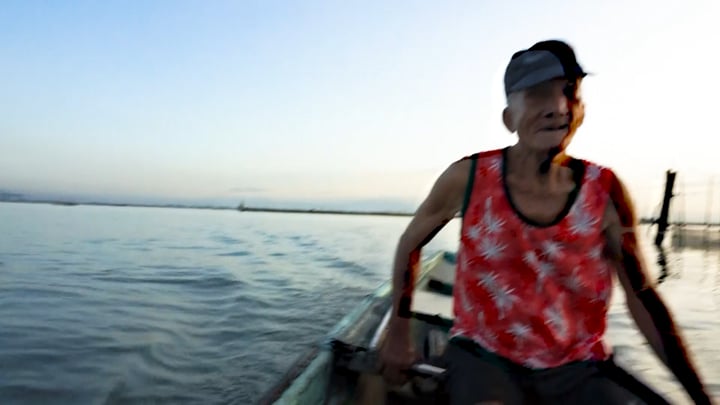


Nang sumabit ang bangka sa lambat sa Laguna de Bay. 2025. Multi-channel video with sounds, 39 min; Salvaged fishing net, scaffolding.